The 7th R.O.C. ( Taiwan )Presidential Innovation Award Report_Youth Category_DATAYOO Shaw Wu General Manager



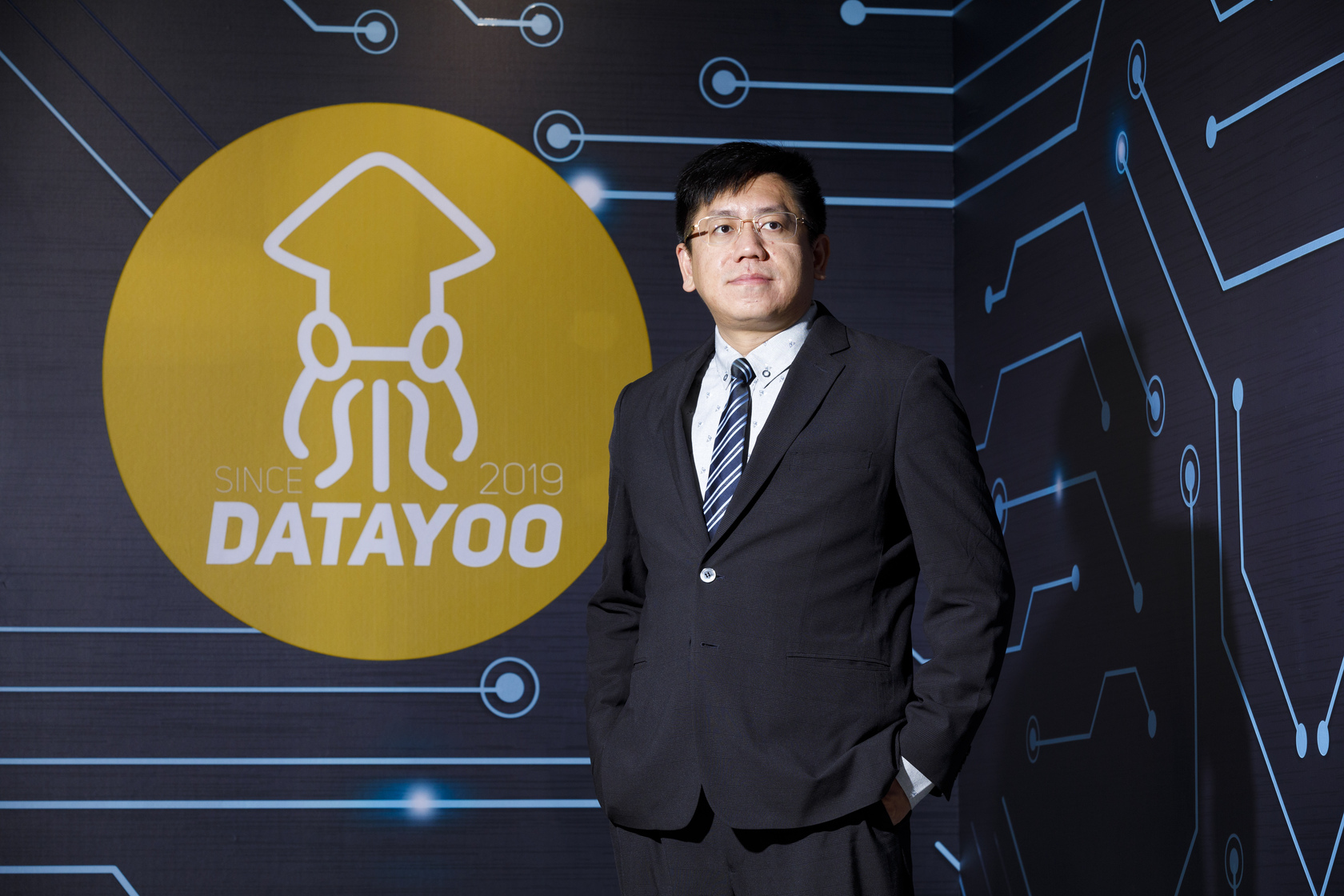
Shaw Wu General Manager
DATAYOO
Youth Category
AgriTech Without Hardware: Scaling Taiwan’s Smart Agriculture Globally
Among Taiwan’s new generation of entrepreneurs, Shaw Wu, Founder and General Manager of DATAYOO, stands out for his distinct approach. Trained as a data scientist, he combines analytical precision, technological expertise, and hands-on field experience to take Taiwan’s agricultural technology global.
Shaw Wu’s path into data science began early, well before the rise of big data. In 2004, while still an undergraduate, he took a course in data mining and was drawn to the potential of data analysis. He went on to pursue both a master’s and a PhD in the field. By his senior year in 2009, he had already been recruited onto a software engineering team at a publicly listed company.
In 2011, he joined the Institute for Information Industry (III). Initially focused on consumer data analysis and cloud platform development, he later moved into client-facing work across sectors including environmental protection, criminal investigation, intelligence, and food safety. In these roles, he transformed fragmented data into predictive models to support decision-making.
“In police intelligence, we encoded behavioral patterns to analyze suspect habits and predict where they might appear, or monitored social media to anticipate criminal activity,”Wu explains.“In food safety, we cross-referenced more than ten public datasets—from tax records to health and business registrations. By identifying specific company profiles, we could pinpoint manufacturers most likely to handle hazardous materials, preventing potential food safety risks before they emerged.”
These experiences convinced Wu that the true value of data science lies not only in finding answers, but in building a framework for continuous prediction and repeatable decision-making.
Leaving Research Behind: Helping Farmers Transform Through Data
Despite a comfortable academic career, Wu chose to launch his own startup. Around 2016, he began developing algorithms for influencer marketing, identifying which products would generate the highest returns for specific target audiences. At the time, the industry was still in its early stages, and the term“KOL” (Key Opinion Leader) was not yet widely recognized.“Whenever I spoke with media professionals about my product, they were impressed by the technology,”Wu recalls,“but they had little sense of how to apply it in practice.”
Although his first venture ended in failure—largely because the technology was ahead of its time—the experience gave Wu a new perspective. He recognized his ability to anticipate trends and build solutions, and believed that when the market matured, he would be well positioned to lead.
He later joined the gov (Civic Tech Prototype Grant) program, where he connected with crossdisciplinary talent to develop a microclimate data system. By deploying sensors and cloudbased analytics, he helped build an open-source community in which scientists and engineers collaborated to analyze field conditions. The team translated complex environmental data into intuitive dashboards, enabling farmers to track weather patterns and pest activity more effectively and support their digital transformation.
Although Wu did not come from a farming background and had no particular interest in the field, he chose agriculture because it had the most fragmented and least quantifiable data. Much of farming knowledge still relies on oral tradition or intuition. For example, in aquaculture, farmers might say, “If the water turns green, the pond will collapse.” Yet no one could define what shade of green this referred to or standardize such observations.
The initial concept behind microclimate data science was to use field sensors to transmit data to a cloud platform, allowing farmers to monitor environmental conditions and pest activity on their phones. But Wu soon realized this approach would not work.
“If a farmer has NT$100,000 to invest in smart agriculture, they might spend NT$90,000 on equipment, leaving only NT$10,000 for analysis,” Wu explains. In other words, while farmers need backend analysis and decision support the most, the majority of their budget is spent on hardware.
To fix this, Wu shifted his strategy toward a more“hardware-free”approach—moving smart agriculture away from a hardware-heavy model and toward a data-driven one.“Removing equipment doesn’t mean we stop using data,”Wu says.“It means finding ways to separate data collection from analysis, lowering the barrier to entry.”
In 2018, a trip to Silicon Valley exposed Wu to capital markets and more mature startup mindsets. A subsequent trip to Indonesia made the stakes even clearer. “The farmland there is vast—a single plot can be as large as an entire city,” Wu recalls. Installing sensors across such terrain would require tens of thousands of devices, while limited communication infrastructure would make data transmission difficult. Wu realized that relying on large-scale, ground-based hardware was not feasible in many regions. The solution, he concluded, lay in a data-driven approach that reduced dependence on equipment.
This shift in thinking was not driven solely by international observations. Early on, when Wu deployed sensors and weather stations, clients often demanded additional measures—such as fencing to prevent theft and nighttime patrols to safeguard equipment—leading to disputes over who should bear the costs. In other cases, clients who provided their own data for modeling later claimed it as proprietary and demanded compensation for its use. These issues complicated the cost structure and blurred the boundaries of responsibility.
Wu then pivoted his business model. To avoid conflicts over data ownership, he developed modeling capabilities that do not rely on client data, allowing DATAYOO to deliver high-precision analysis without accessing sensitive information. Instead, the company prepares its own data, while clients subscribe to the service and the models improve over time through use. Although this approach is technically demanding—requiring advanced automation and strong modeling expertise—once in place, data is no longer a barrier to collaboration. Instead, it becomes a powerful competitive advantage.
Data is King: Accuracy That Speaks for Itself
How can data be captured at scale without relying on physical sensors? When Wu founded DATAYOO in 2019, he introduced FarmiSpace, a crop monitoring system that combines satellite spectral data with AI models. By analyzing spectral signals invisible to the human eye, the system can identify field boundaries, crop types, and crop health across the entire growth cycle.
This non-contact, large-scale monitoring capability now supports 189 crop varieties, with accuracy exceeding 98%. On the global stage, FarmiSpace has established a strong competitive position. Even players such as SpaceX’s Starlink, despite their extensive satellite networks,struggle to compete in this space without comparable data modeling capabilities.
Wu recalls that a skeptic once questioned FarmiSpace’s accuracy and wagered NT$1,000,000 that physical sensors would outperform the model. After three rounds of testing, FarmiSpace delivered near-zero error, turning the skeptic into a client.
Another advantage of this equipment-free approach, Wu notes, is its ability to address one of the most difficult variables in farming: human behavior. On large-scale farms, tasks such as spraying, weeding, and harvesting still rely heavily on manual labor. Workers may exploit blind spots to cut corners—for example, spraying only the perimeter or harvesting only the most visible areas—leaving crops in the field’s interior unattended and reducing overall yield.
“One client told us they had tried using wearable trackers to monitor staff, only to find that forest canopies blocked the signals, creating a technical gap,” Wu says. “Some workers even tied the devices to dogs to generate false data.”
Drawing on these frontline challenges, Wu expanded FarmiSpace from a monitoring tool into a broader platform that tracks crops, workflows, and workforce efficiency—significantly increasing its value to clients
Practical Success: Smart Agriculture Puts Taiwan on the Global Map
Wu and his team have taken Taiwan’s smart agriculture abroad, delivering impressive results through international projects. In St. Kitts and Nevis, they improved watermelon cultivation, increasing yields by 27%. In Guatemala, they developed a growth model for broccoli that identified more effective planting windows, raising yields by 32%.
Beyond improving single-crop yields, FarmiSpace integrates weather, soil, and satellite data with existing sensors and field management systems. In 2022, the platform was used in a disaster warning project in Guatemala, integrating data from ground stations and satellite feeds across eight cities. By 2023, Wu had introduced models for corn growth and carbon sequestration, alongside precision drone management. Yields increased by over 10%, water use was reduced by half, and carbon emissions fell by an average of 560 kg per hectare.
In 2024, Wu was invited to the International Banana Quarantine Forum in Guatemala to present how FarmiSpace detects risks such as Panama Disease for Bananas (Yellow Leaf Disease). His approach was subsequently adopted by OIRSA, supporting plant quarantine and crop health monitoring efforts across Central and South America.
In 2024, Wu expanded his strategy into Southeast Asia through a partnership with the Indonesian AgriTech firm Eratani to launch satellite land monitoring and realtime data analysis. The service now covers four Indonesian provinces and reaches more than 20,000 farmers. In another collaboration with Blessed Bentara Agri, FarmiSpace supported crop monitoring across rice paddies in the Java region. Its rice blast detection results in the Karawang region achieved a 98% overlap with actual ground surveys. These successes confirm the potential of "de-equipmentization"—proving that disease risks can be tracked effectively without expensive, high-density sensor networks.
These international successes reinforced Wu’s conviction: for AgriTech to be sustainable, it cannot rely on subsidies or pilot projects alone—it must be built on a viable business model.
“Agriculture is a business, not a charity,” Wu says bluntly. He argues that while Taiwan’s long-standing agricultural subsidies are wellintentioned, continuous financial support can hinder farmers from adopting technology in a way that contributes to a self-sustaining cycle. When technology remains free or dependent on grants, it becomes difficult to maintain consistent use or drive ongoing improvement.
Wu believes the real value lies in building a business model that is both accessible and sustainable. DATAYOO adopts a subscription model that lowers the barrier to entry by simplifying the user experience. Instead of managing complex hardware, farmers can monitor their fields directly from a smartphone—tracking fertilization timing, nutrient uptake, and soil conditions with ease. Only when a solution is simple, affordable, and precise can advanced technology be fully integrated into smart agriculture.
Learning from the Best: Mentorship as a Catalyst for Growth
Shaw Wu’s transition from data scientist to CEO was not a solo journey; he credits three key mentors for shaping his path. A senior executive from a top-five global Indonesian pineapple company taught him the fundamentals of corporate management at scale. Silicon Valley veteran Wu-Fu Chen introduced him to capital markets, offering guidance on staged growth, fundraising, and long-term corporate strategy. The Dean of the College of Bio-Resources and Agriculture provided industry insight, grounding him in both technical expertise and the realities of fieldwork.
Wu acknowledges that he is not a “born entrepreneur.” Aware of the limits of his own expertise, he actively draws on his mentors to g ui de the company's cross-sector growth.
In just six years, DATAYOO has expanded its smart agriculture services across 32 countries, with satellite-based monitoring now covering more than two billion hectares of land worldwide. As a representative of Taiwan’s private sector, Wu presented at the WTO’s 9th Aid for Trade Global Review, where he shared how AI and satellite data have empowered nations across Latin America. Together, Wu and DATAYOO demonstrate how Taiwanese innovation can operate in complex, real-world environments—redefining the future of smart agriculture through industry-leading expertise.
Mantra for Success
- Moving beyond traditional hardware frameworks, Wu prioritizes a hardware-free approach over physical sensor deployment. By integrating satellite spectral data with risk modeling, he shifts agriculture from experience-based practices to precision-driven management.
- Wu translates data models into practical field applications. He has developed scalable business models to address climate variability, pest risks, and water resource management, establishing a technology-driven approach to modern agricultural management.
- Wu leverages Taiwan’s technical foundation to drive international expansion. He has scaled operations across Southeast Asia and global markets, adapting his analytical models to diverse crops and environments while elevating Taiwan’s profile in data science and smart agriculture.
- As DATAYOO expands globally, Wu brings Taiwanese innovation into international markets and builds trust through real-world application. By deploying smart agriculture solutions in partner countries, he has improved local management and risk assessment, laying the groundwork for cross-border technical collaboration
得獎感言-DATAYOO Shaw Wu General Manager
Innovation remains an idea until it is put into practice; real-world application defines a true solution. Beyond localized application, DATAYOO is bringing Taiwan's agricultural technology onto the global stage.
Picture list
- Date of announcement:2026/06/01
- Last updated: 2026/07/22
- Views:120