
The 7th R.O.C. ( Taiwan )Presidential Innovation Award Report_Group Category_One-Forty



One-Forty
Group Category
Empowering the "One-Forty": Pioneering a More Inclusive Society
On weekends, the checkered hall of Taipei Main Station becomes a gathering place for migrant workers from Indonesia, Vietnam, Thailand, and the Philippines—a vivid crosssection of lives. While many see it as part of the city’s everyday backdrop, for One-Forty founder Kai-Hsiang Chen, it became the starting point of a decade-long effort toward social change.
In 2015, Chen—a graduate of National Chengchi University’s College of Commerce—chose a different path from his peers in finance, turning his focus to Taiwan’s “oneforty” demographic. He founded One-Forty to address the structural challenges facing migrant workers.
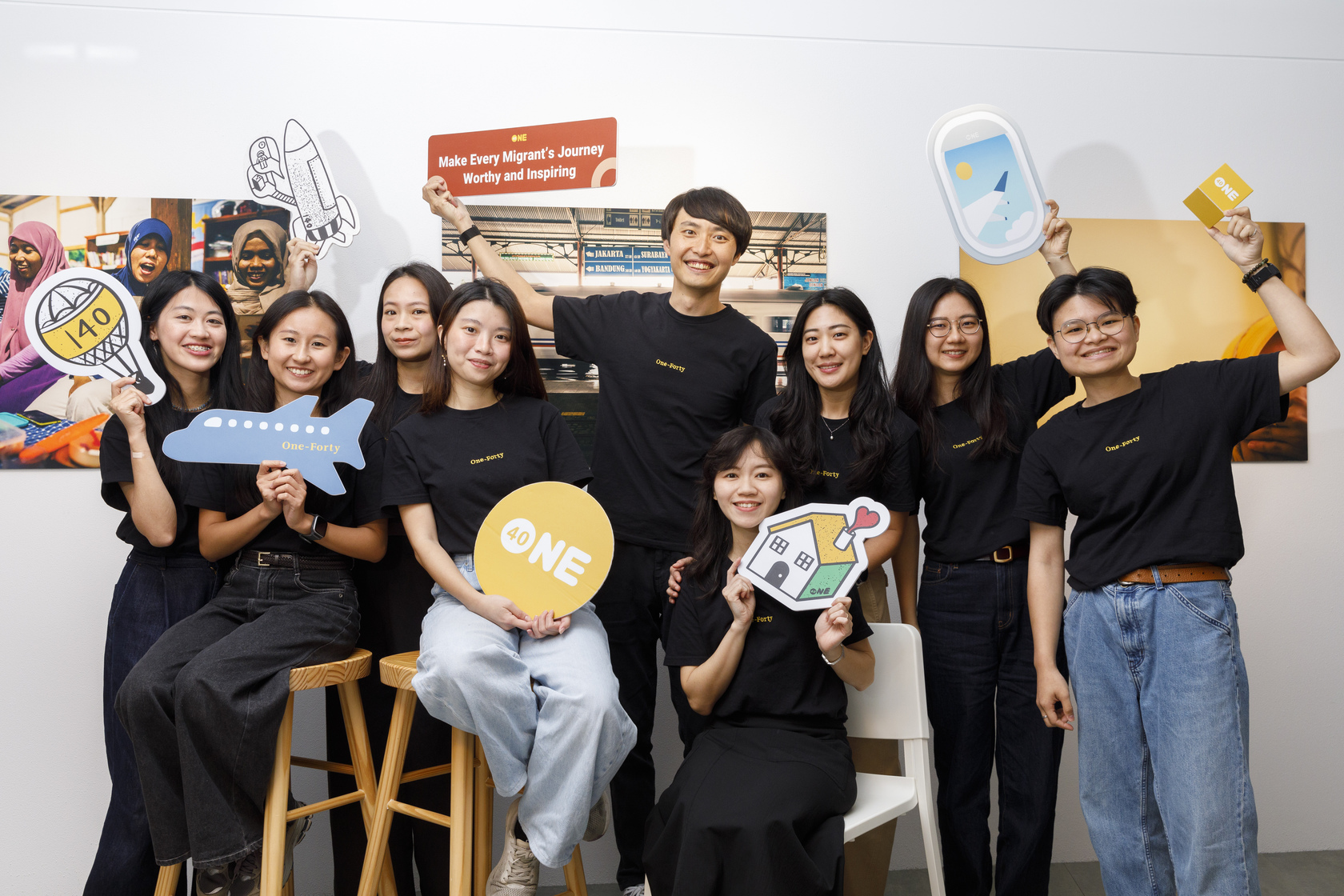
Today, his team—averaging around 30 years of age—supports a learning community of more than 120,000 migrant workers, the largest of its kind in Taiwan. OneForty has grown into a cross-border network, supporting career transitions and building an alumni community across Southeast Asia. The organization has driven a quiet revolution, working with partners across industries to raise awareness of migrant issues while helping bridge the cultural gap between workers and the Taiwanese public.
Migrant labor is a long-standing reality in Taiwan, but One-Forty’s approaches are by no means traditional. The organization often works across industry, government, and academia with the next-generation mindset.
From Business School to NPO
One-Forty’s workspace carries the energy of a Silicon Valley startup rather than a traditional charity. The story began with Chen’s volunteer work in India and the Philippines after graduation. Observing how professional NPOs operated firsthand, he began to see the deeper, structural connections between Southeast Asian migrant workers and Taiwan.
In the Philippines, many people he met had relatives working in Taiwan or were planning to migrate themselves. These encounters prompted Chen to look more closely at the issue. After returning to Taiwan, he balanced a consulting job with grassroots volunteering at Southeast Asian bookstores and Indonesian community groups, teaching Mandarin as a way to better understand the lives of these “neighbors.”
He soon identified a critical need: many migrant workers came to Taiwan to improve their families’ financial situation, yet had limited access to financial literacy and entrepreneurship training. Drawing on his business background, Chen launched the “Migrant Business School” in 2015.
The initiative began with simple outreach, including handing out flyers at Taipei Main Station. Despite initial rejections, 25 students attended the first session. The program addressed an overlooked need and quickly gained traction through word of mouth and social media. After completing the first threemonth cycle, Chen left his consulting role to build One-Forty full-time.
Education as an Investment for Social Impact
Chen sees education as the most effective way to support migrant workers, given its lasting impact. For him, the idea of “long term” goes beyond the five to ten years workers spend in Taiwan; it extends to their opportunities for upward mobility after they return home.
To put this into practice, One-Forty has built a comprehensive, tuition-free Migrant School. The curriculum spans language learning—covering Mandarin and Taiwanese—alongside financial literacy, entrepreneurship, and vocational skills such as caregiving and basic computer use. These programs support daily life in Taiwan while laying the groundwork for future career development.
Nearly one-quarter of One-Forty’s 40 staff members are Southeast Asian educators who develop native-language materials. Demand for these resources is strong: while physical classrooms can accommodate only 300 to 400 students each year, the organization received around 3,000 applications within a week of opening registration this year.
To reach Taiwan’s nearly 900,000 migrant workers, One-Forty launched a digital platform in 2017. It now hosts more than 500 instructional videos, covering topics from professional skills to navigating local healthcare and transportation systems. The platform has attracted over 120,000 subscribers, and its flagship mobile app has been downloaded more than 30,000 times, serving as a key entry point for workers arriving in Taiwan.
Chen emphasizes that One-Forty supports the entire migration journey—from predeparture preparation to learning in Taiwan, and ultimately to applying these skills back home.
Alumni Data and the Talent Pipeline
The impact of education is evident in over 200,000 Taiwanese employer households. As migrant workers improve their Mandarin, they gain a deeper understanding of the elderly they care for. This enhances not only the quality of care, but also the dynamics within the family.
For many workers, One-Forty is life-changing. It tracks its alumni each year and has found that many returnees use their language skills and cultural fluency to move into management or translation roles at Taiwanese-owned companies in their home countries.
By building professional Facebook alumni networks where Taiwanese firms can post job openings, One-Forty has created a regional talent pool. This initiative is helping reposition Taiwan from a “labor importer” to a “talent incubator,” providing a steady pipeline of talent for Taiwanese companies operating under the New Southbound Policy.
Other alumni apply their entrepreneurial training to local ventures. Success stories include a factory owner employing 18 people, a poultry farmer raising a flock of 6,000, and restaurant owners introducing Taiwanese staples such as bubble tea to local markets.
“We want to ensure every migrant’s international journey is meaningful,” Chen says. When workers are able to improve their lives back home, they begin to see their time in Taiwan as a lasting asset for their future.
Multi-Sector Collaboration to Scale Social Impact
One-Forty recognizes that driving systemic change requires a coordinated effort. By working across industries, the organization focuses on professional training, inclusive workplace design, and better consumer experiences, turning social challenges into tangible outcomes.
「終端客戶雖然給元太一張大訂單,交貨期卻很緊迫。李董在臺灣追不到貨,他得知當時的群創董事長王志超跟我人在深圳,專程飛了一趟,極力爭取更多產能。」楊柱祥表示:「最後,我們特地把竹南總部的4.5代產能,優先調撥來支援,讓元太如期交貨。」
“We center our strategy on the daily lives of migrant workers,” Chen explains. In the retail sector, One-Forty partnered with FamilyMart to introduce multilingual communication guides and Muslim-friendly food options across more than 4,000 stores.
In telecommunications, it worked with FarEasTone to produce instructional content for mobile connectivity, addressing an immediate need for migrant workers.
The organization has also advanced financial inclusion through partnerships with various banks and insurance companies. Together, they developed native-language resources to guide workers through account opening and fraud prevention, while supporting banks in meeting fair treatment standards.
In healthcare, collaborations with major hospitals have streamlined patient registration and expanded access to mental health resources. Even Taiwanese landmarks such as Taipei 101 and the National Palace Museum have improved their visitor navigation systems using insights from One-Forty.
Outreach also extends to campuses. OneForty has introduced Southeast Asian cultural curricula into schools across Taiwan, reaching 4,000 teachers and 6,000 students. This early exposure helps foster a more globally minded and inclusive perspective among the next generation.Over the past decade, One-Forty has partnered
with more than 100 companies. Chen sees this growing network as a sign that industry leaders increasingly recognize the migrant community not only as a social priority, but also as an emerging consumer group. With a large base of engaged users acting as real-world testers, OneForty helps businesses extend corporate social responsibility into opportunities to refine their services and expand market presence.
Dismantling Stereotypes Through Cultural Exchange
Beyond supporting migrant workers, One Forty aims to foster public understanding to reduce bias and challenge stereotypes. “Taiwanese already embrace Southeast Asian tourism and cuisine,” Chen observes. “The challenge is finding ways to break through social barriers.”
To address this, One-Forty has curated more than 100 cultural events, including music festivals, photography exhibitions, and culinary workshops. Recent high-profile collaborations include the“Sunshine Island Festival”with the Kaohsiung City Government—which drew 200,000 visitors in three days—and a photography exhibition hosted by the Tainan Art Museum.
Similar efforts have reached more than 500,000 participants over the past decade, serving as an ongoing social experiment in reducing stigma. Chen notes that the shift is often most visible in everyday settings: employers develop a deeper appreciation for their caregivers’cultural backgrounds, while educators increasingly incorporate Southeast Asian perspectives into their teaching. “Change builds over time,” he says, “when it begins in daily life.”
Raising Taiwan’s Profile as a National Employer
As Japan, South Korea, and Singapore compete for Southeast Asian talent, Taiwan’s strategy must shift from simply securing to attracting and retaining labor. Chen identifies“national employer branding”as a key differentiator. By strengthening Taiwan’s international appeal and reputation, the country can remain a destination of choice for global workers.
One-Forty helps create a virtuous cycle. When migrant workers leave Taiwan with better skills, positive experiences, and improved prospects in life, they become the country's most credible advocates.
Each year, over 100,000 workers complete their contracts and return home. Chen sees them as“seeds”— ambassadors whose experiences in Taiwan contribute to a form of grassroots diplomacy, while also raising the country’s international visibility.
Over the years, Taiwan’s social climate has shifted in meaningful ways. A growing number of companies, schools, and government agencies now take a more active role in addressing migrant issues. The fact that employers increasingly enroll their workers in One-Forty’s programs reflects a promising sign of change.
While running an NPO presents ongoing challenges, Chen draws motivation from the tangible changes he sees in participants’ lives. Many describe their time in Taiwan as one of the most valuable periods of their lives, often referring to One-Forty as a “second home.”
Amid an aging population and declining birth rates, Taiwan’s future is closely tied to the migrant community. One-Forty’s decade of work mirrors Taiwan’s transition into a more inclusive society. By reframing the“one-forty”population as partners with skills and aspirations, rather than simply a labor force, the organization has helped drive a quiet but lasting transformation. In doing so, it not only supports those who come to Taiwan, but also helps illuminate the country’s own path forward.
Mantra for Succes
- One-Forty has built Taiwan’s largest Southeast Asian migrant learning community, reaching more than 120,000 participants. Its courses span language learning, entrepreneurship, financial literacy, and vocational skills. Through a hybrid online-and-offline model, the organization ensures nationwide access to educational resources, empowering workers to build new opportunities.
- It has also developed a regional talent pipeline for returnees by establishing a specialized non-profit recruitment platform. By matching workers with Mandarin proficiency and experience in Taiwan with Taiwanese companies in Southeast Asian countries, the initiative transforms returning migrants into a valuable talent pool.
- Through partnerships across retail, finance, healthcare, and telecommunications, One-Forty has integrated migrant support into the corporate sector. These collaborations focus on professional training, inclusive workplace design, and improved consumer experiences—extending social impact across industries.
- The organization has also led various cultural initiatives, including music festivals, photography exhibitions, and culinary events, bringing migrant communities and the Taiwanese public together. To date, these programs have engaged more than 500,000 participants, contributing to a more inclusive society while enhancing Taiwan’s global profile.
得獎感言- One-Forty Founder & CEO Kai-Hsiang Chen
These 100,000 individuals are seeds. When their experience in Taiwan is positive, they return home as the best ambassadors for the country.
Picture list
- Date of announcement:2026/06/01
- Last updated: 2026/07/22
- Views:127